
Global FinTech Go-to-Market Strategy: Why Local Execution Wins
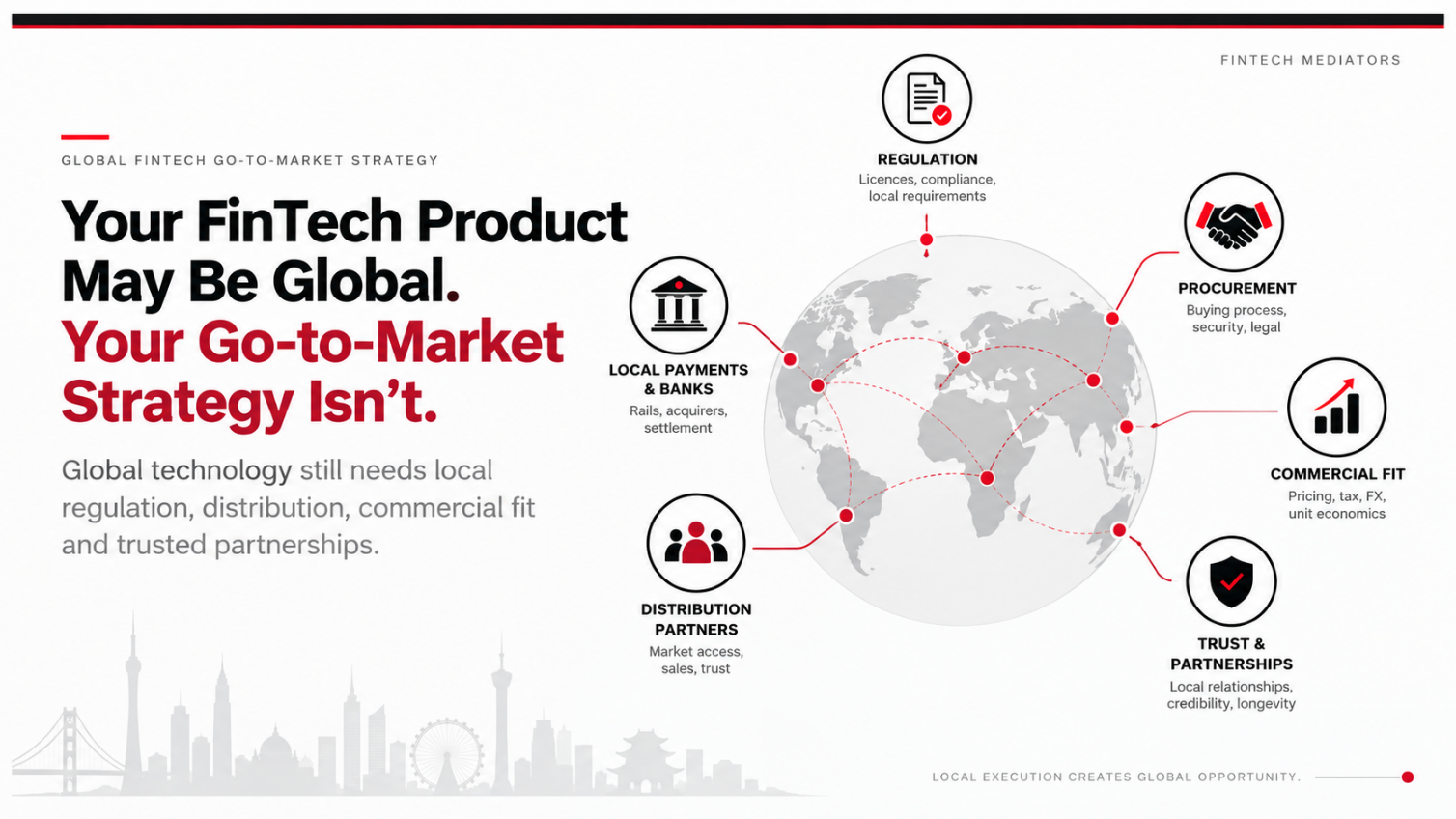
Your technology may cross borders instantly. Your licensing, distribution, buyer relationships, pricing and trust do not.
By Ross Haider | FinTech Mediators | Updated September 2026
One of the most persistent misconceptions I have encountered during more than thirty years in payments and FinTech is that a successful technology can simply be exported into another country.
Technically, perhaps. Commercially, rarely.
A FinTech platform may be delivered globally through APIs and cloud infrastructure, but financial services still operate through local rules, local institutions and local buying behaviour. Regulation is local. Payment rails are local. Banking relationships are local. Procurement is local. Commercial expectations are local. Trust is local.
That is why international expansion should not begin with a longer prospect list. It should begin with a market-entry model.
Why a Great FinTech Product Does Not Guarantee Distribution
There are excellent technology companies offering issuing platforms, acquiring infrastructure, payment orchestration, fraud and risk management, tokenization, POS technology, data enrichment, identity, compliance tooling and other financial solutions. Many are technically capable of serving multiple regions. Far fewer have a repeatable way to enter those regions.
The constraint is often not product quality. It is distribution: the combination of access, regulatory fit, local credibility, commercial structure and execution that moves a product from “available in this market” to “actually bought and implemented in this market.”
A European FinTech entering the Middle East may have no meaningful route into local banks or PSPs. A GCC payments company entering Africa may misunderstand acquiring structures, settlement relationships or local procurement. An Asian infrastructure provider entering Europe may underestimate vendor-risk processes and regulatory expectations. A North American business entering an emerging market may discover that its pricing model fails once tax, FX, revenue share and local willingness to pay are included.
This is why hiring a sales representative and handing over a database is rarely a complete international expansion strategy. Sales activity is downstream of market design.
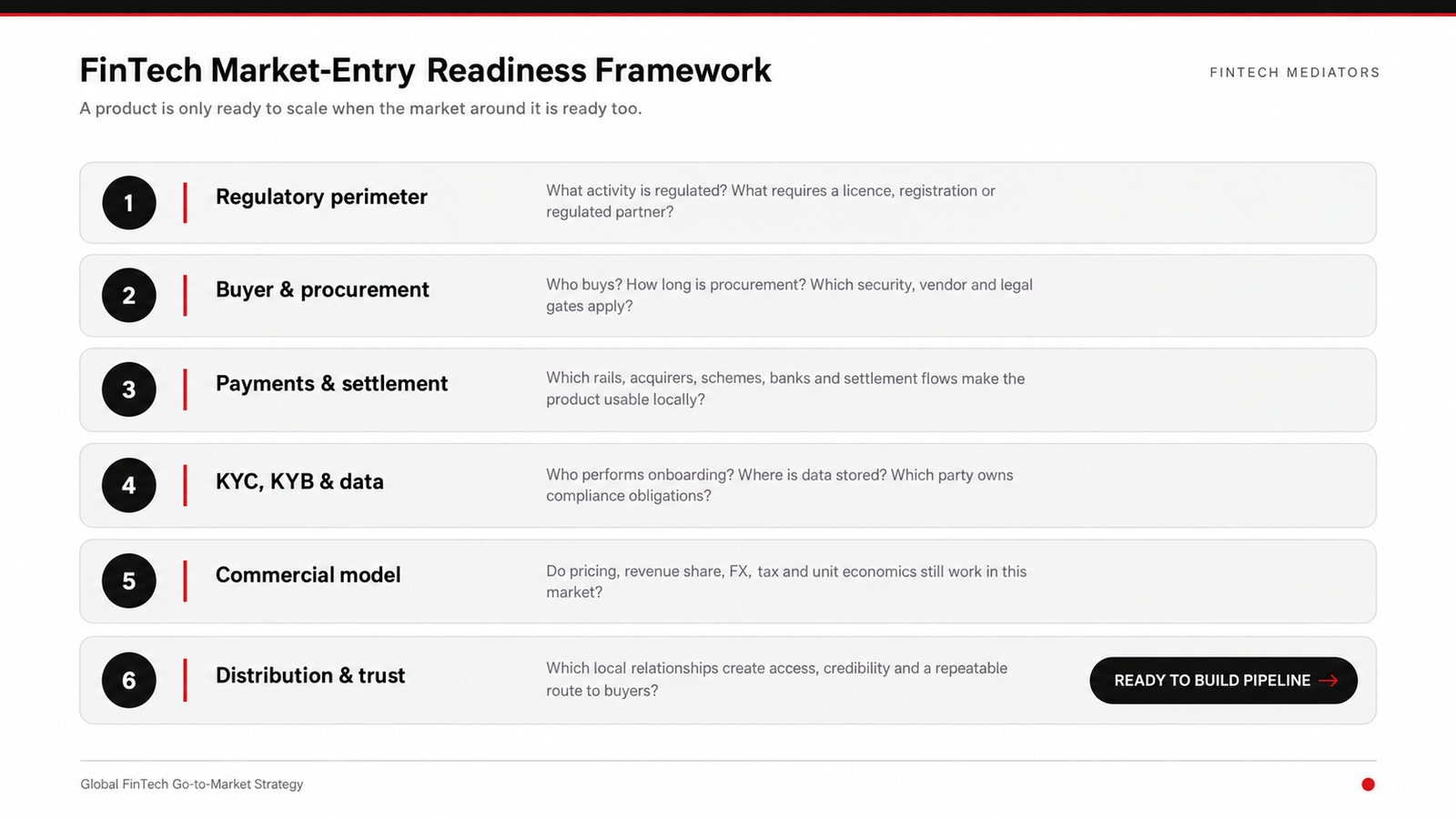
Figure 1. The six layers that should be clear before a FinTech company scales outbound sales in a new market.
Treat Regulation as Part of the Route to Market
In FinTech, regulation is not a legal workstream that sits beside go-to-market. It directly shapes what can be sold, who can sell it, who can contract with the customer, who can hold or move funds, who performs onboarding and which partner relationships are required.
The point is especially visible in MENA. In March 2026, the Saudi Central Bank (SAMA) issued an updated Oversight Framework for Payment Systems and their Operators, aligning the oversight approach with the Kingdom’s Payments and Payment Services Law and clarifying supervisory methodology and operator obligations.[1] In the UAE, the Central Bank’s Open Finance Regulation establishes a regulated framework built around an API Hub, Trust Framework and common infrastructure, while its Payment Token Services Regulation sets licensing or registration requirements for activities such as payment-token issuance, conversion, custody and transfer.[2][3]
For a company planning market entry, the practical question is not simply “Is FinTech growing here?” It is “What role are we legally and commercially able to play in this ecosystem?”
Before building a pipeline, answer the operating questions that define the offer:
- What activity, if any, requires a licence, registration, approval or regulated local partner?
- Can the product be supplied as technology to a regulated institution, or does the provider itself enter the regulated activity?
- Who owns the merchant, bank, enterprise or end-customer relationship?
- Who performs KYC or KYB, sanctions screening and ongoing compliance?
- Who holds, safeguards or settles funds?
- Where may customer and transaction data be stored and processed?
- Which party carries regulatory, operational and contractual liability?
- What outsourcing, information-security, scheme or vendor approvals are needed?
- How should pricing, revenue share and responsibility be reflected in the commercial contract?
Those questions should be answered before sales targets are set. Otherwise a team can create demand for an operating model that cannot be contracted, licensed, implemented or priced sensibly.
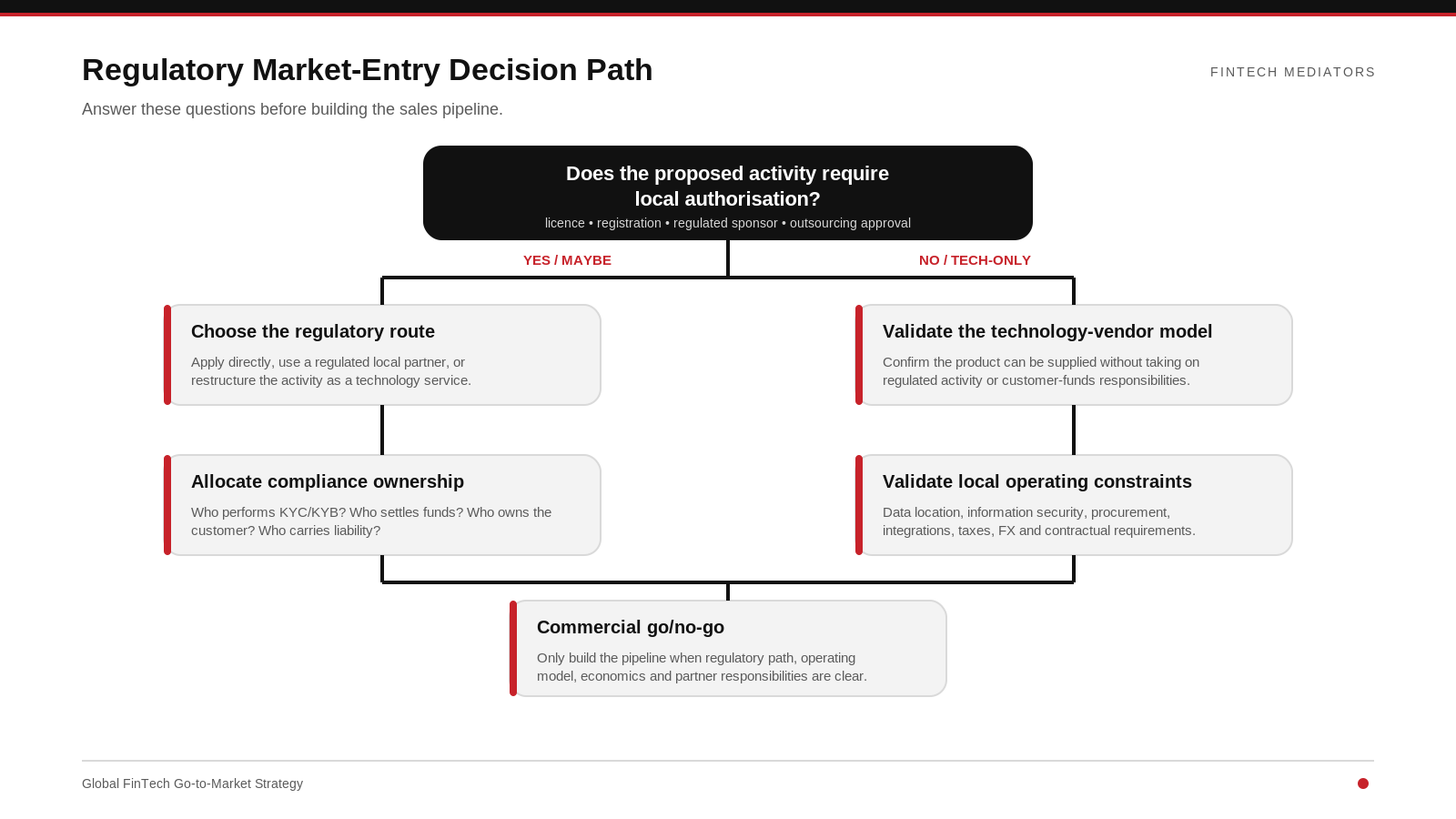
Figure 2. Regulation and operating responsibility should be resolved before the sales pipeline is built.
Choose the Right FinTech Market-Entry Model
There is no single correct way to enter a new country. The best structure depends on the product, regulatory perimeter, buyer, expected volume, appetite for capital investment and the strength of available partners. In practice, most market-entry strategies fall into a small number of models.
|
Model |
Speed |
Capital / control |
Regulatory load |
Best fit |
|
Direct regulated entry |
Slower |
High / high |
High |
Long-term strategic market where scale justifies a licensed local operating structure. |
|
Technology vendor |
Medium |
Low-medium / high product control |
Lower, but not zero |
Infrastructure or SaaS sold to banks, PSPs or regulated institutions that retain regulated responsibilities. |
|
Regulated local partner |
Faster |
Lower / shared |
Shared through partner structure |
Products that need regulated capabilities, safeguarding, settlement or local sponsorship. |
|
Reseller / distributor |
Faster |
Low / lower commercial control |
Depends on activity |
Products that can be distributed locally and need buyer access, language, relationships or sales coverage. |
|
JV / strategic alliance |
Medium |
Medium-high / shared |
Shared |
Markets where both sides contribute strategic assets and intend to build a durable local business together. |
The legal and regulatory feasibility of each model must be assessed market by market.
The Partnership Economy: Why FinTech Expansion Is Becoming More Modular
Not every FinTech company needs a licence in every country. Not every payments provider needs to build every capability. Not every technology company needs its own sales organisation in twenty markets.
A more capital-efficient route is often to combine complementary strengths. A technology provider supplies the platform. A regulated financial institution supplies the licensed perimeter, safeguarding or settlement capability. A local payments company supplies connectivity and market knowledge. A distribution partner opens relevant buyer relationships. An implementation specialist helps move from contract to production.
That structure can reduce the amount of duplicated infrastructure required for each new market. It can also shorten the distance between a technically capable product and a commercially credible local proposition. But the model only works when responsibilities are explicit and incentives remain aligned.
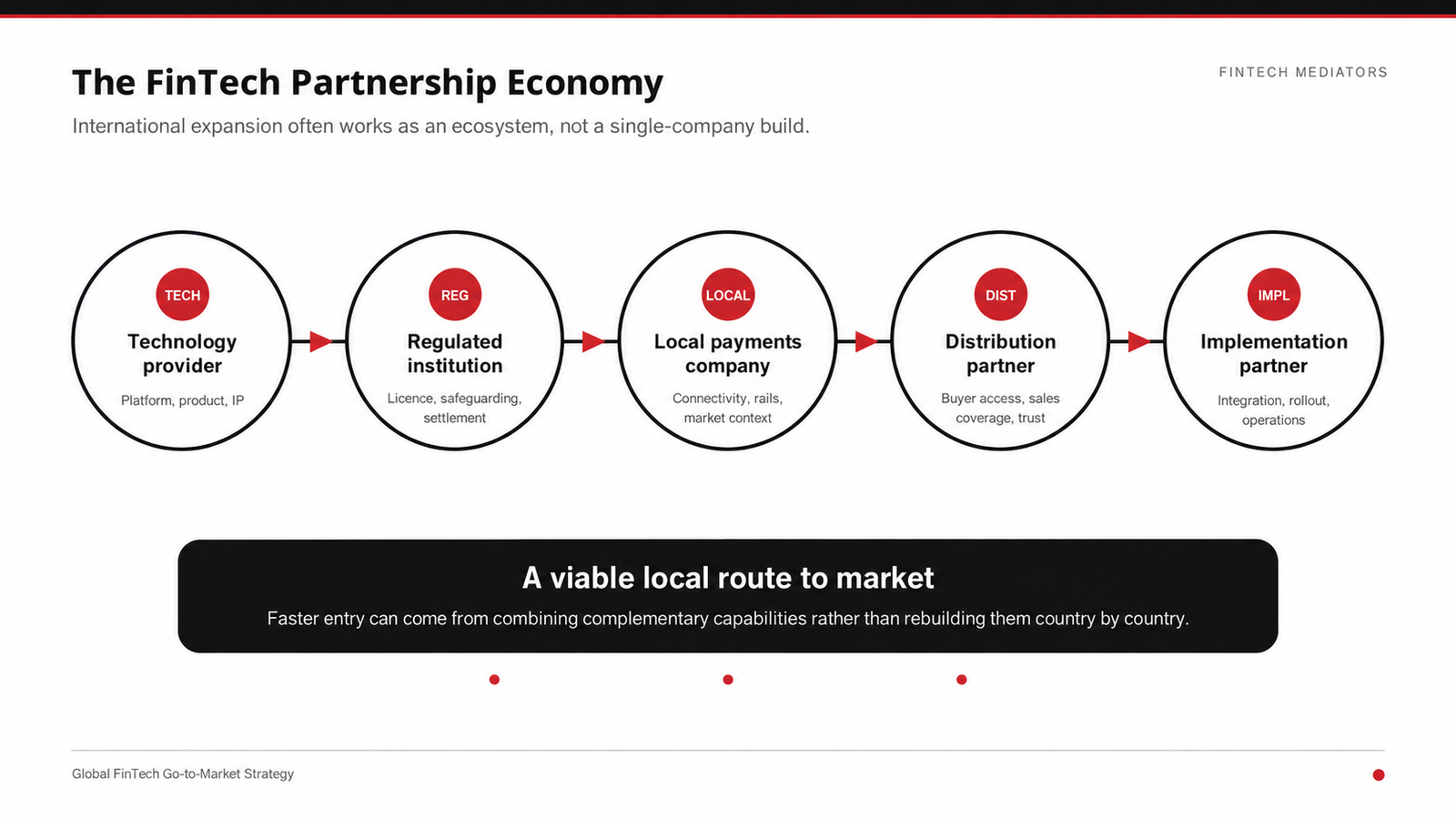
Figure 3. International FinTech expansion can be designed as a partner architecture rather than a full rebuild in each market.
An 8-Step Global FinTech Go-to-Market Playbook
The strongest international go-to-market programmes tend to follow a deliberate sequence. The order matters because each step reduces uncertainty for the next one.
- Define the buyer and the problem — Identify the specific bank, PSP, merchant segment, enterprise or public-sector buyer. Clarify the economic or operational problem, the buying trigger and the person who owns the budget.
- Choose the market on fit, not headline size — Assess demand, regulatory accessibility, competitive intensity, partner availability, buyer concentration, implementation complexity and realistic access to decision-makers.
- Map the regulatory and operating model — Document which entity contracts, which entity is regulated, who performs KYC/KYB, who handles funds, who stores data, who settles and who carries liability.
- Build the local economics — Rework pricing for tax, FX, revenue share, minimum commitments, support costs, integration effort, local payment economics and the margin expected by partners.
- Design the partner architecture — Decide where banks, acquirers, PSPs, distributors, resellers, implementation partners or strategic introducers are genuinely required — and where direct selling is better.
- Localise the commercial sale — Adapt proof points, objections, procurement materials, security documentation, contracts and commercial language to the actual buying process. Localisation is more than translating a deck.
- Pilot a narrow, measurable use case — Start with a buyer and implementation scope that can produce evidence. Define success metrics, responsibilities, deployment milestones and the route from pilot to commercial scale.
- Scale what became repeatable — Only add headcount and broader outbound once the company can repeat buyer access, partner performance, contracting, integration and support without rebuilding the playbook for every deal.
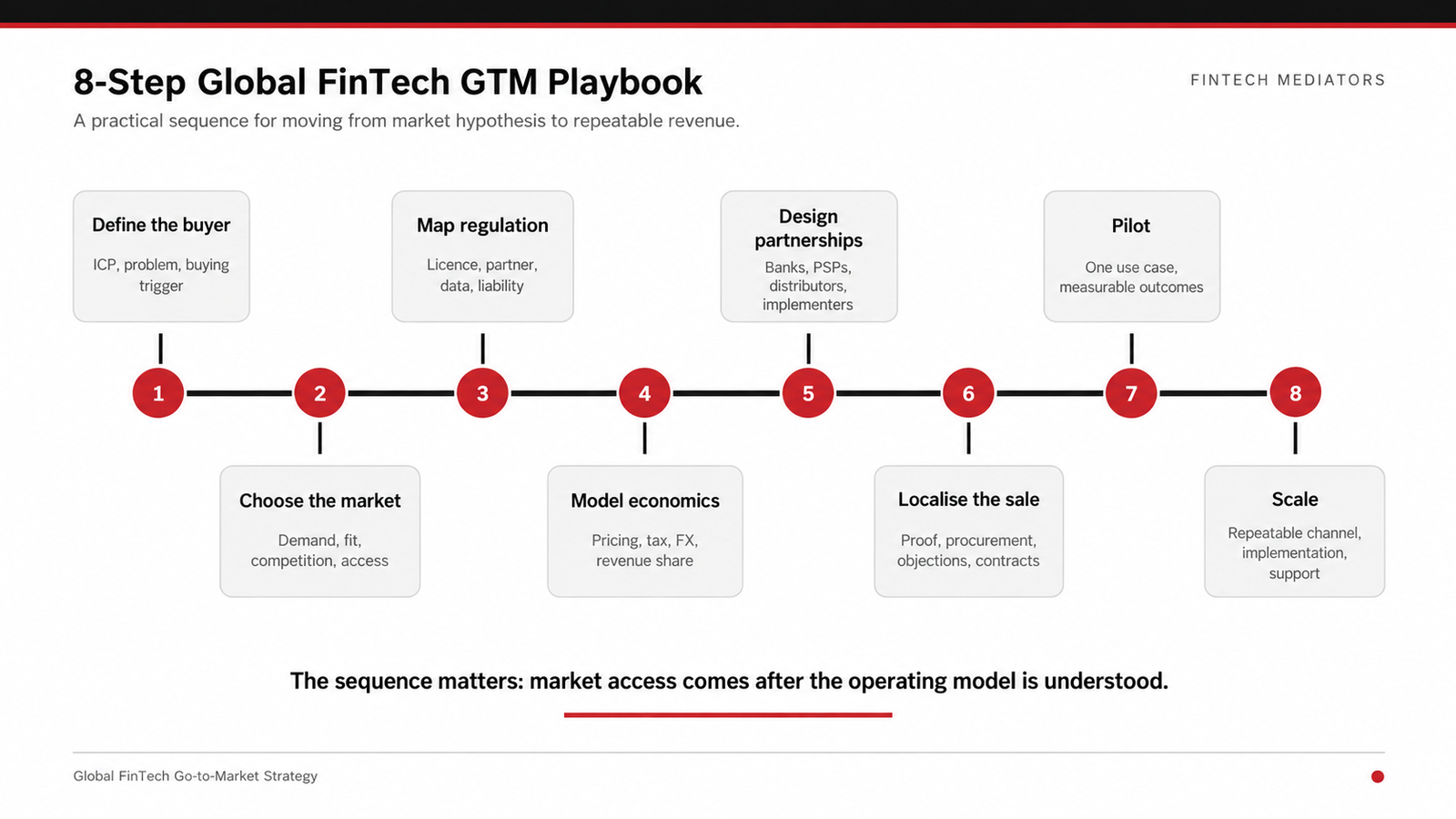
Figure 4. A practical order of operations for international FinTech market entry.
How to Evaluate a Local FinTech Partner
The word “partner” is used too loosely in international expansion. A useful partner should contribute something the company cannot efficiently create alone — regulatory coverage, distribution, infrastructure, implementation capacity, credibility or access to specific buyers. The relationship should be assessed commercially, not socially.
- Licence and scope: confirm the partner is authorised for the exact activities the proposed model relies on, not merely “regulated” in a broad sense.
- Buyer access: ask which institutions, merchants or sectors the partner can reach and how those relationships have converted historically.
- Technical fit: confirm APIs, scheme connectivity, settlement, security, reporting, support and integration responsibilities before commercial launch.
- Commercial alignment: define margin, revenue share, minimums, sales ownership, lead protection, territory and renewal economics.
- Implementation ownership: establish who manages onboarding, project delivery, support, incident management and escalation after the contract is signed.
- Data and compliance: document how data flows, which entity performs KYC/KYB, how complaints and disputes are handled, and where regulatory liability sits.
- Exclusivity discipline: avoid granting broad exclusivity before the partner has demonstrated measurable market access and execution capability.
- Reputation and resilience: assess governance, financial stability, regulatory history and the operational consequences if the partner relationship ends.
Common FinTech Expansion Mistakes
Most international failures do not come from one dramatic error. They come from several reasonable assumptions that were never tested locally.
- Choosing a market from TAM or growth headlines without checking whether the company can actually contract, settle, integrate or distribute there.
- Hiring local salespeople before defining the regulatory route, target buyer and partner model.
- Assuming pricing that worked in the home market will survive local tax, FX, partner margin and procurement pressure.
- Treating one bank introduction or conference conversation as a distribution strategy.
- Underestimating vendor onboarding, information-security review, legal negotiation and implementation lead times.
- Giving a reseller or strategic partner exclusivity before evidence of pipeline quality, execution capacity and conversion.
- Focusing on the signed contract while neglecting implementation, support and the operational work required to reach live transaction volume.
- Failing to decide who owns the customer, data, compliance process and liability before negotiations become deal-specific.
Where FinTech Mediation Creates Value
In many markets the core problem is not that buyers and sellers do not exist. They do not have an efficient way to find, qualify and structure a workable relationship with each other.
A bank in Africa may need a modern issuing platform. A European technology company may already have it. A PSP in the Middle East may need advanced fraud management. A specialist provider in Asia may have the right capability. The opportunity exists, but the commercial connection, regulatory context or implementation path may not.
That is where a specialised intermediary can add value: not simply by producing leads, but by understanding the buyer’s problem, identifying relevant solution providers, testing commercial fit, introducing the right parties and helping the relationship move from initial discussion toward an executable structure.
The value of mediation is highest when the intermediary understands both ecosystems — what the buyer is actually trying to solve and what the provider can realistically deliver in that local market.
Frequently Asked Questions About Global FinTech Go-to-Market Strategy
What is a FinTech go-to-market strategy?
It is the commercial and operating plan for taking a financial-technology product to a defined buyer in a defined market. For international expansion, it should cover regulatory perimeter, target customer, procurement, pricing, distribution, partnerships, implementation and post-sale support.
Can a FinTech company enter a country without getting its own licence?
Sometimes. A company may be able to sell technology to a regulated institution or operate through an appropriately authorised local partner. In other cases the activity itself requires the provider to obtain a licence or registration. The answer depends on the exact product, activity and jurisdiction.
Is hiring a local sales representative enough for market entry?
Usually not on its own. A sales representative can create coverage, but cannot replace a clear regulatory model, commercial structure, partner architecture, local proof and implementation capability.
What is the difference between a distribution partner and a regulated partner?
A distribution partner primarily provides commercial access and sales coverage. A regulated partner provides licensed or supervised capabilities that the operating model depends on. One company can sometimes play both roles, but the responsibilities should still be separated clearly in the agreement.
How should a FinTech company choose its first international market?
Prioritise the market where product demand, regulatory feasibility, buyer access, partner availability, economics and implementation complexity create the strongest combined case. Market size alone is not enough.
When should a FinTech company use an intermediary?
An intermediary is most useful when market access is relationship-driven, the buyer landscape is difficult to navigate, multiple partners are needed, or the provider needs help qualifying opportunities and structuring introductions before committing to local headcount.
How long does international FinTech expansion take?
There is no universal timeline. A technology-vendor sale through an existing regulated buyer can move very differently from a launch that needs licensing, scheme approval, local incorporation, integrations or a new settlement structure. The right planning metric is time to a legally executable and operationally live model — not time to the first meeting.
Global Technology. Local Execution.
Over the years I have learned that successful international expansion requires both a global perspective and local execution. The strongest technology does not always win. The largest company does not always win. The company with the most salespeople does not always win.
Very often, the company that succeeds is the one that understands the ecosystem: the regulator, the buyer, the payment infrastructure, the partner economics, the implementation path and the relationships that turn a product into a local proposition.
In global FinTech, who you connect with can be just as important as what you build. But the real advantage comes from connecting the right parties around a structure that can actually be licensed, contracted, implemented and scaled.
Regulatory References
- Saudi Central Bank (SAMA) — Updated Oversight Framework of the Payment Systems and Their Operators, 24 March 2026. Official source
- Central Bank of the UAE — Open Finance Regulation, C 03/2025, issued 10 July 2025. Official source
- Central Bank of the UAE — Payment Token Services Regulation, C 2/2024, effective 31 August 2024. Official source
Editorial note: Regulatory requirements depend on the exact activity and jurisdiction. This article provides strategic market-entry guidance and is not legal advice.